Brick and Stone Crawl Space Restoration in Denver, CO
Crawl spaces are the most neglected part of most Denver homes, and the masonry walls inside them take more abuse than almost any other surface on the property. Constant moisture exposure, minimal airflow, no sunlight, and freeze-thaw stress from the soil outside: it's a harsh environment, and most crawl space masonry shows it.
At Denver Brick Specialists, we restore brick and stone crawl space walls that have deteriorated to the point of allowing moisture intrusion, losing structural integrity, or simply falling apart. We've been doing this work across the Denver metro since 1965. The fact that no one sees it doesn't mean it doesn't matter.
Why Crawl Space Masonry Deteriorates
Moisture. Crawl space walls are below or at grade, in direct contact with soil that retains moisture. Water migrates through concrete block, brick, and stone, especially when mortar joints are open or parging has failed. Once moisture gets into the masonry, freeze-thaw cycles do the rest.
Freeze-thaw cycling. Denver's winters feature repeated freeze-thaw events that are brutal on saturated masonry. Water expands as it freezes, forcing mortar joints open wider and accelerating spalling.
Biological growth. Damp, dark conditions promote efflorescence, mold, and in some cases root intrusion through deteriorated joints.
Age. Many Denver crawl space walls were built in the postwar housing boom of the 1940s through 1960s and haven't had masonry maintenance in decades.
Lack of maintenance. A small crack in a mortar joint becomes an open channel for water. Open parging becomes saturated block. Saturated block becomes spalling.
What Crawl Space Restoration Includes
Repointing Deteriorated Mortar Joints
Open, eroded, or crumbling mortar joints are the primary entry point for moisture. We remove deteriorated mortar to the appropriate depth and repoint with mortar matched to the existing masonry in strength and composition. Getting the mix right matters in crawl spaces: too hard traps moisture and causes spalling; too soft won't hold up to the conditions.
Parging and Surface Waterproofing
On concrete block and rough brick or stone walls, a parge coat applied over repointed joints provides a unified, water-resistant surface. We apply parging mortar to the interior or exterior face of the crawl space wall, or both, depending on conditions.
Brick and Stone Replacement
Where individual bricks or stones have spalled, cracked, or deteriorated beyond repair, we replace them with matching material and repoint the surrounding joints. In historic Denver homes with original stone foundations, sourcing the right replacement material and matching the mortar carefully is something we take seriously.
Crack Repair
Mortar joint cracks and surface cracks are repointed. Wider or active cracks are evaluated for cause, whether settlement, lateral soil pressure, or moisture cycling, before we determine the appropriate repair approach.
Cleaning and Efflorescence Removal
Salt deposits indicate active moisture movement through the masonry. We remove efflorescence, treat the surface, and address the underlying moisture pathway before applying any protective coating.
Crawl Space Masonry in Denver's Older Homes
Sandstone foundations. Many late 19th and early 20th century Denver homes were built on locally quarried sandstone. Sandstone is relatively soft and porous, and original lime mortar joints have often eroded significantly. Repointing these walls requires a soft, lime-based mortar. Portland-dominant mixes that are harder than the stone will cause it to spall.
Concrete block (CMU) walls from the postwar era. Block walls from the 1940s through 1960s are extremely common in Denver crawl spaces. The block itself is usually sound, but mortar joints have eroded and original parging has often failed entirely, leaving block cells exposed to moisture.
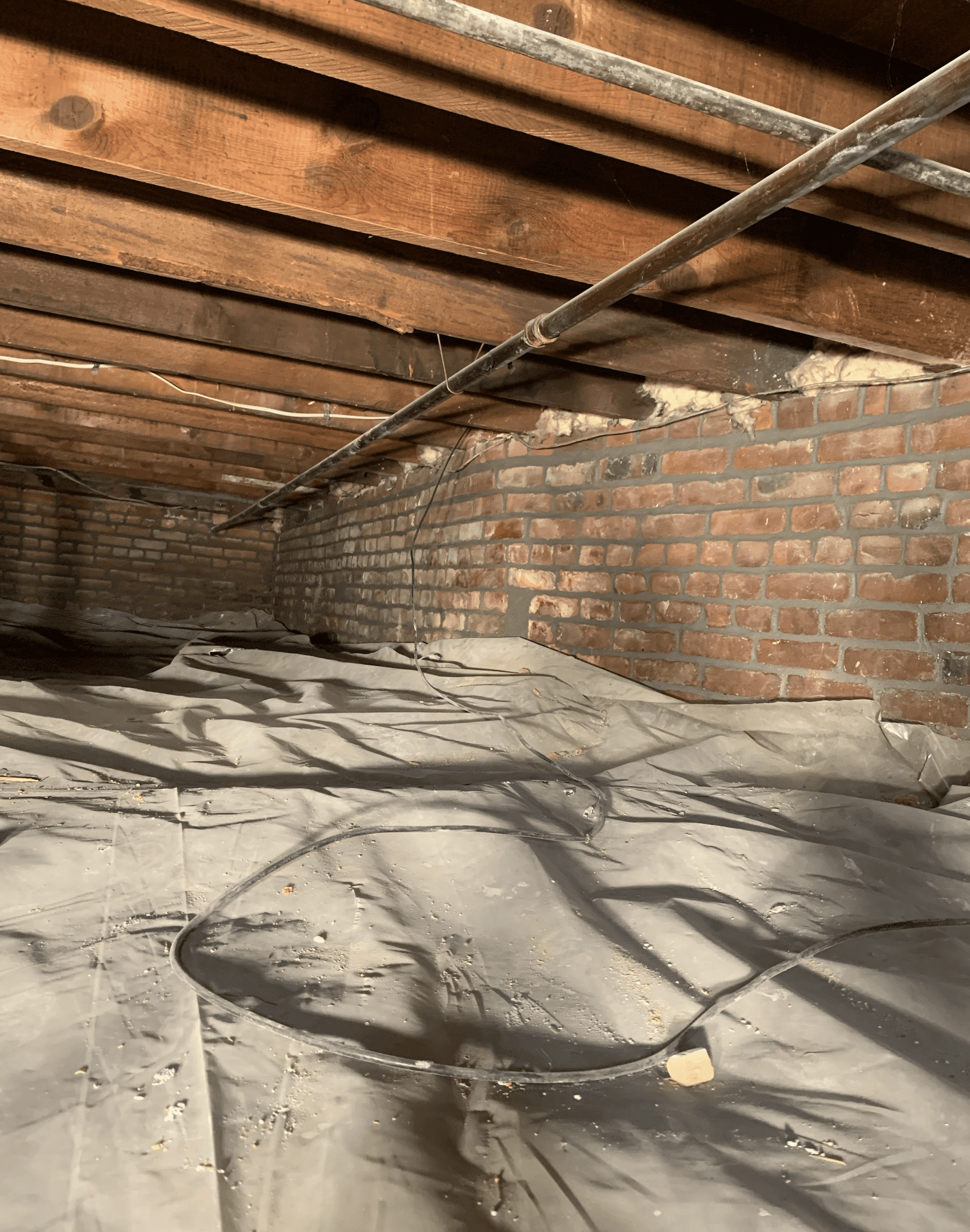
Brick crawl space walls. Present in some of Denver's prewar homes. Generally in better condition than stone given brick's relative impermeability, but mortar joint deterioration and moisture intrusion at the base are common.
In all cases, the restoration approach needs to be calibrated to the original materials. We've been working with historic Denver masonry long enough to know what's appropriate, and what will cause more damage.
Crawl Space Masonry and Moisture Problems
If you're seeing moisture in your crawl space, failing masonry walls are frequently a contributing factor, though rarely the only one. Open mortar joints and failed parging allow groundwater and soil moisture to migrate directly through the wall. Once inside, that moisture raises humidity, promotes mold growth, and can migrate upward into floor assemblies and living spaces.
Restoring the masonry addresses the wall itself, but it doesn't change the hydrostatic pressure from surrounding soil or the drainage conditions around the foundation. We'll tell you honestly what the masonry work will and won't address. We don't oversell the scope of what masonry restoration alone can do when a moisture problem has multiple causes.
Our Process
1. Inspection and Assessment. We crawl the space and evaluate wall conditions: mortar joint integrity, parging condition, cracking, moisture staining, efflorescence, spalling, and any visible structural concerns. We document what we find and give you a clear scope of work.
2. Scope Definition. We identify which walls or sections need full restoration versus targeted repair, and what combination of repointing, parging, crack repair, or unit replacement is appropriate.
3. Preparation. We clean surfaces, remove failing parging and loose mortar, and prepare the substrate. On older stone foundations, this often means careful hand work to avoid damaging original material.
4. Masonry Repair and Repointing. Deteriorated mortar is removed and replaced. Individual failed units are replaced where needed. We match mortar color and composition to the existing wall.
5. Parging Application (Where Applicable). Where conditions warrant it, we apply a parge coat over repointed joints to create a unified, water-resistant surface.
6. Final Walkthrough. We walk through the completed work with you and identify anything worth monitoring.
Frequently Asked Questions
How do I know if my crawl space walls need restoration? Common signs: visible mortar joint erosion, crumbling or flaking brick or stone, failed or missing parging, efflorescence, moisture staining, or visible cracks. If your crawl space is damp and the masonry hasn't been inspected in years, it's worth a look. We offer free estimates.
Does crawl space restoration fix moisture problems? Restoring deteriorated masonry reduces one pathway for moisture entry. Whether it resolves your moisture problem depends on what else is contributing — surface drainage, groundwater, vapor transmission, ventilation. We'll give you an honest assessment.
Can you work on old stone foundations? Yes. We have specific experience with Denver's historic stone foundation types, sandstone in particular, and we understand how to select the right mortar and approach for older lime-based construction. Using the wrong mortar on a historic stone foundation causes more damage than it fixes.
How long does crawl space restoration take? Typical projects take one to three days depending on the size of the crawl space and scope of work.
What's the difference between repointing and parging for a crawl space wall? Repointing addresses the mortar joints between individual units. Parging applies a continuous mortar coat over the entire wall surface. They're complementary. Repointing restores joint integrity first; parging then creates a unified protective layer over the top. On some walls repointing alone is sufficient; on others, especially block or rough stone, parging is the right next step.